Phugtal Monastery is not on the way to anywhere. It clings to a cliff face above a lateral gorge of the Lungnak river in south-eastern Zanskar, 52 kilometres southeast of Padum, its white cells stacked around the mouth of a cave like a honeycomb. Roughly seventy monks live there. And for one winter, two hundred years ago, so did a Hungarian.
The cave of leisure — or of liberation
Most accounts of Phugtal skip past the name, which is a shame, because it contains a small puzzle. The first syllable is uncontested. The second depends on which spelling you follow — and the difference turns a place of rest into a place of release.
That the alternate reading exists at all is a detail worth holding onto. A cave of leisure is a place to rest. A cave of liberation is a place to work. Phugtal has been both, and the man who arrived in 1826 came firmly for the second.
The scholar who walked to Zanskar
Alexander Csoma de Kőrös was a Transylvanian Hungarian who set out east to find the origins of his own people and ended up, by a long and improbable route, in Ladakh. Between 1826 and 1827 he worked at Phugtal on what would become the first English–Tibetan dictionary — the foundational text of Tibetan lexicography in the West. A stone tablet at the monastery commemorates the stay.
A man walked to the end of the road, then past it, and spent a winter in a cave building the tool everyone after him would need.
It is worth pausing on the logistics of that. There was no road. Supplies reached Phugtal by horse, donkey and mule in summer, and across the frozen river in winter. Csoma worked through a Zanskari winter at 3,800 metres, in a cliffside cave monastery, compiling a language no European had systematically catalogued. The dictionary he produced is still the ancestor of every Tibetan–English reference that followed.
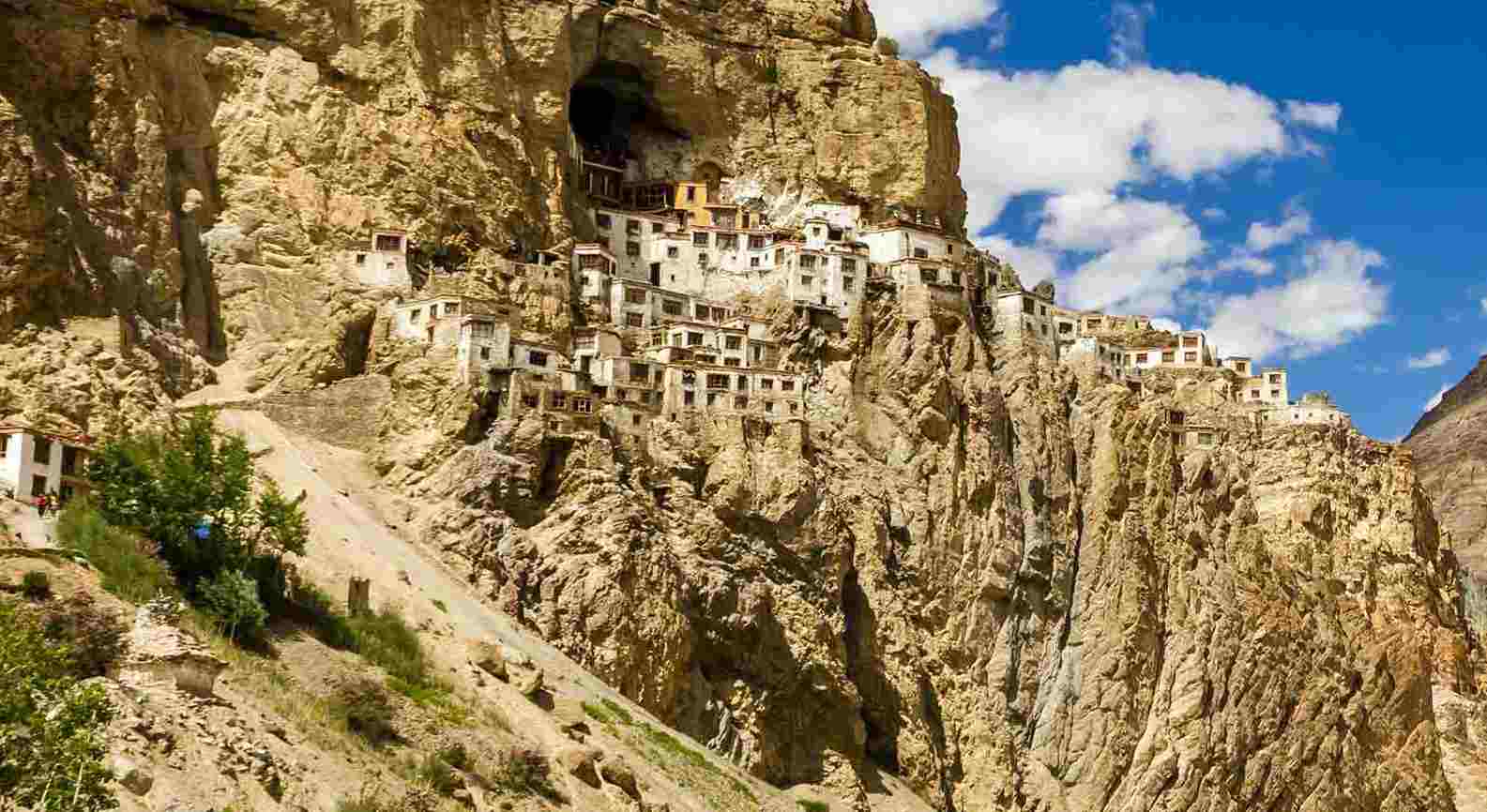
The monastery is built into the cliffside like a honeycomb, its cells stacked around the mouth of the cave at roughly 3,800 metres.
Phugtal Gompa · click to enlarge
Before the monastery, the cave
The gompa as it stands was established in the early fifteenth century by Jangsem Sherap Zangpo, a disciple of Je Tsongkhapa. Legend holds that Zangpo caused a spring to appear from the cave, a tree to grow above it, and the cave itself to enlarge — the monastery then rising around it under his guidance. The spring is still there, and still protected.
The cave, though, is held to be far older. Tradition places sages, scholars and translators there some 2,550 years ago, with the sixteen Arhats among its earliest residents; their images appear on the cave walls. Padmasambhava is believed to have stayed, as are Phakspa Nestan Dusdan and Marpa Lotsawa. In the twelfth century the translator Zanskar Lotsawa Phagpa Sherab worked from Phugtal — which makes Csoma, seven centuries later, not the first lexicographer to choose this cave, only the first European one.
Three scholar-brothers — Dangsong, Pun and Sum, credited in local tradition with the power of flight — are said to have taught dharma at the site and bequeathed it to Jangsem Sherap Zangpo on his arrival.
The approach to Phugtal, and the monastery in its gorge
A working monastery, not a ruin
It would be easy to write Phugtal as a relic. It isn't one. Alongside the main temple, prayer rooms and living quarters, the monastery holds a library of rare texts, teaching facilities and a kitchen. The Phuktal Monastic School was founded in 1993 at the behest of Geshe Lharampa Nagri Choszed, combining traditional Buddhist study with a modern curriculum. It charges no fees — the monastery covers room, board and materials. There is also a Tibetan medical clinic with a resident Amchi practising Sowa-Rigpa, much of it prepared on site.
Which is to say: two hundred years after Csoma sat down to compile a dictionary here, Phugtal is still a place where people come to study. That continuity is the actual story, and it survived a serious test in recent memory.
The bridge and the trail are maintained by the monks themselves and the people of Cha. If you walk in, you are walking on infrastructure that a village and a monastery keep open by hand.
Getting there, honestly
This is not a day trip from Leh, and any guide that implies otherwise is selling you something. Padum is roughly two days from Leh via Kargil, or about 240 kilometres on the partially complete Nimmu–Padum–Darcha road. Phugtal is another 52 kilometres beyond that, and the last stretch is on foot.
The season is short. The road typically opens in late May or June and closes by late October. The Shinku La tunnel, under construction since July 2024 and expected around 2028–29, would eventually make this an all-weather route — but that is some years off, and as of May 2026 police were advising that only 4×4 vehicles be permitted near Shinku La.
For accommodation there are basic guesthouses and homestays in Purne and the nearby villages, plus a guesthouse run by the monks at the foot of the cliff — traditional rooms, bucket washrooms, communal vegetarian meals.
The trip you plan the rest of Ladakh around
The honest framing for a guest at Kesaar Palace is this: Phugtal is not something you add to a Leh itinerary. It is something you build an itinerary around. Committing to Zanskar means committing the better part of a week, and it works best with Leh at either end — days of acclimatisation before you attempt 3,800 metres, and somewhere to land afterwards.
That acclimatisation is not a formality. Altitude sickness at Phugtal is a genuinely serious problem, because the nearest road is a two-to-three hour walk away and the nearest hospital considerably further. Guests who spend their first days in Leh, at 3,500 metres, arrive in Zanskar already adjusted. It is the difference between a hard trek and an unsafe one.
What waits at the end is a cliff full of monks who have kept a cave, a spring and a library going for six centuries, and who once made room for a Hungarian with a notebook and an improbable idea. He finished the dictionary. The cave is still there.
