Sumur, Nubra
Samstanling was founded by a trader who gave up his business late in life, named by a letter from Tibet, and has twice been the childhood ground of the man Ladakh calls its most important modern figure. Most visitors drive past it on the way to Hunder.
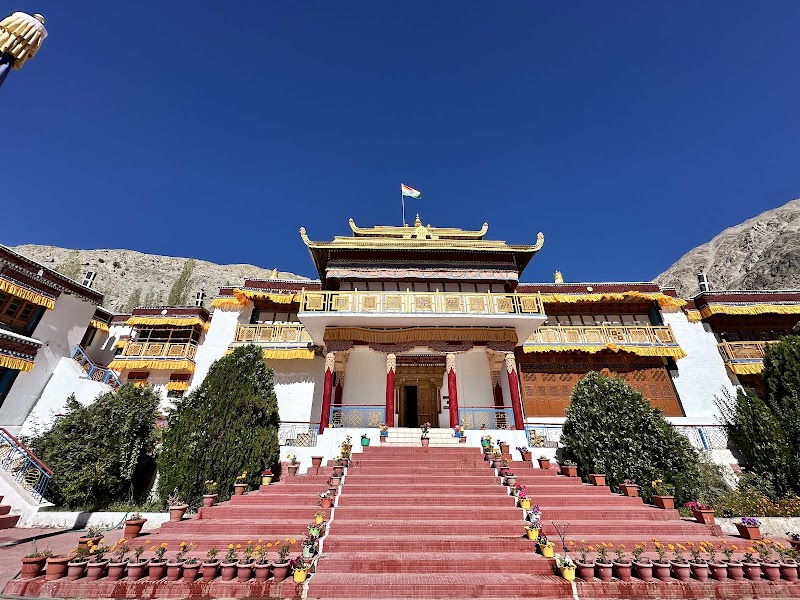
At Khalsar the road splits. Almost everyone goes left, towards Diskit and the Maitreya statue and the camel rides at Hunder. Go right instead, up the Nubra river towards Panamik, and about twenty minutes on you will see a cluster of buildings standing above the village of Sumur, visible long before you reach them.
This is Samstanling, the principal monastery of this side of the valley. It is quieter than Diskit by a wide margin. It is also, by some distance, the more interesting story.
Samstanling was founded in 1848 by Tsultrim Nyima, and the detail most pages leave out is that he did not begin as a monk at all. He was a Ladakhi trader. He married a woman named Yangzom when he was twenty-nine, and they had a son and a daughter. It was only after Yangzom died while he was away travelling, and then his teacher Geshe Mila died during another journey, that he turned towards renunciation.
Both of his children eventually entered monastic life. His son, ordained by his own father, earned a geshe degree and became known as Geshe Rabgye; the reincarnations of that line are the Se Rinpoches.
Tsultrim Nyima founded Rizong as well as Samstanling, and both houses became known for something specific — an unusually strict adherence to the Vinaya, the monastic code. That reputation is still part of how Ladakhis talk about these two gonpas.
He is also credited with protecting monasteries during the Dogra invasion of Ladakh in 1834, led by the general Zorawar Singh Kahluria. The account that survives has him going to Zorawar Singh directly and acknowledging the defeat of the Ladakhi resistance. He offered two things: a piece of brocade and a white ceremonial khatag, which he told the general represented the earth and the sky. Your rule over this region is like the sky, he is reported to have said — so be merciful to the people under it.
The name was not chosen locally. It arrived by letter from Tibet.
On the founding, 1848Fourteen years after that encounter, the monastery was built. The name Samstanling was given by the Seventh Panchen Lama, Tenpai Nyima, in a letter sent from Tibet — a detail that says something about how connected this apparently remote valley was to the centres of Gelug learning.
You will find a number of well-ranking pages dating this monastery to the fifteenth century, or describing it as founded "140 years ago" — a phrase copied around the internet a decade or more ago and never updated. Neither is right. The reliable date is 1848, which makes it approaching 180 years old.
If you flew into Leh, you landed at Kushok Bakula Rimpochee Airport. Most visitors read the name off the terminal and never learn whose it is.
The Nineteenth Bakula Rinpoche — Ngawang Lobzang Thubstan Choknor — has a fair claim to being the most consequential Ladakhi of the twentieth century. Born in 1917 into the royal house of Matho, recognised as a young child and sent to Drepung in Tibet for his training, he returned to become a monk, scholar and statesman at once. When the Fourteenth Dalai Lama and tens of thousands of Tibetans crossed into India in 1959, he was central to re-establishing Tibetan Buddhist institutions in exile. He was close to Nehru, sat in the legislature, received the Padma Bhushan in 1988, and served as India's ambassador to Mongolia, where he is widely credited with reviving Buddhism as the Soviet system came apart. Mongolia gave him its Polar Star. Leh's airport took his name in 2005.
He was not raised at Samstanling — that was Spituk, after Matho. But as a child he spent his winters here, in this valley, in this gonpa.
The stronger connection is the one still unfolding. The Twentieth Kushok Bakula Rinpoche was born in January 2005 in Kyagar, the village immediately beside Sumur. He was introduced to monastic life at Samstanling before his enthronement at Spituk in August 2010. So this is not a monastery with a famous visitor in its past. It is where the current holder of the line began.
There is a third strand: Rizong Rinpoche, nephew of the Nineteenth Bakula and abbot of Drepung Loseling, has also served as abbot of Samstanling — tying it back to the other monastery Tsultrim Nyima founded.
Several travel pages still describe a small boy incarnate at the monastery guesthouse, tying protection threads on visitors' wrists. That was written around 2010 and never revised. The child in those accounts is an adult now. Do not arrive expecting it.
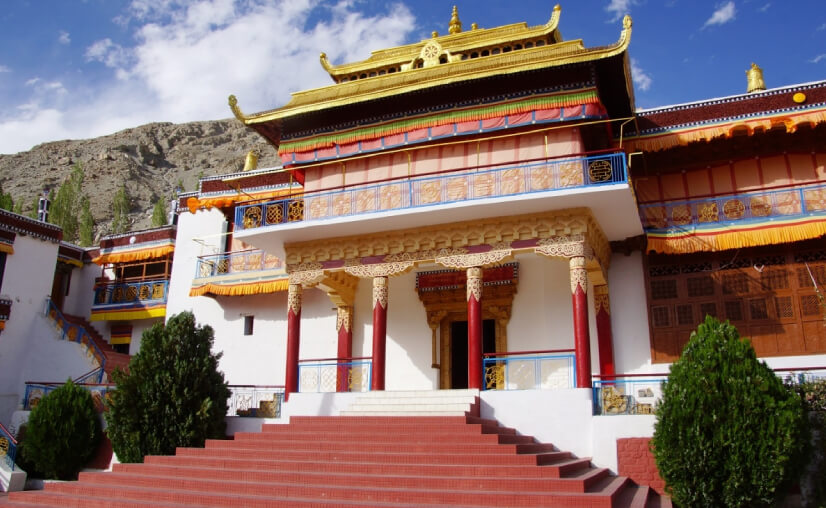
Roughly fifty monks are in residence. There are two assembly halls, both carrying murals and painted images of the Buddha, the Four Heavenly Kings and other guardian figures, with the Dharmachakra recurring through the wall paintings. The path up runs past berry bushes, and the steps to the entrance are lined with prayer flags.
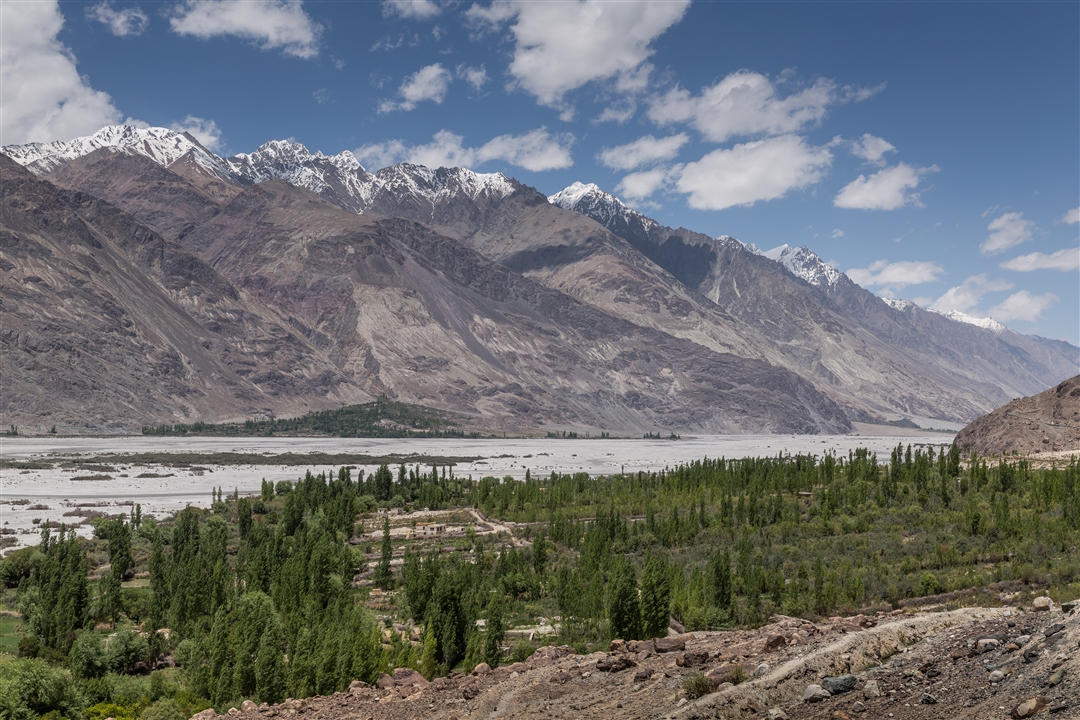
The setting does a good deal of the work. Sumur sits where the Nubra valley widens out, and the monastery stands high enough above the village that the view back down takes in the orchards, the braided river and the bare wall of mountains on the far side. Most visitors give it half an hour on the way to somewhere else. It rewards longer, and it rewards early — before the vehicles returning from Diskit start moving back through Khalsar.
Timings and access in Nubra change without notice. Confirm before you set out — our front desk checks these regularly.
It was founded in 1848, making it approaching 180 years old. Claims that it dates to the fifteenth century, or that it is around 140 years old, appear on several travel sites but are not supported by the scholarly record.
Yes, and for different reasons. Diskit has the scale and the famous Maitreya statue. Samstanling is quieter, is the main monastery of the Sumur side of the valley, and carries the connection to the Bakula lineage. They sit on opposite forks of the same road, so both fit comfortably into one Nubra trip.
Yes. Nubra Valley requires an Inner Line Permit, arranged before you leave Leh. There is no separate entry charge at the monastery itself.
Between June and September, when Khardung La is dependably open and the valley is at its most accessible. The wider season runs from roughly May to September, but early and late in that range the road can be affected by snow.
The Nineteenth Bakula Rinpoche was a Ladakhi monk, scholar and statesman who helped re-establish Tibetan Buddhist institutions in India after 1959, served as India's ambassador to Mongolia, and received the Padma Bhushan. Leh's airport is named after him. He spent winters at Samstanling as a child, and the Twentieth Bakula Rinpoche, born in nearby Kyagar in 2005, began monastic life at the monastery.
Nubra is a two-day trip from Leh done properly, and most people try to do it in one. If you are planning the valley, our front desk handles Inner Line Permits and can tell you what the Khardung La road is doing that week. Hotel Kesaar Palace is on Fort Road in Leh.
