Twenty Kilometres West
Phyang was founded on a vision of a protectress riding a blue horse. Five centuries later its lineage-holder looked at a shrinking glacier and asked an engineer to build an artificial one. The same institution, doing the same job.
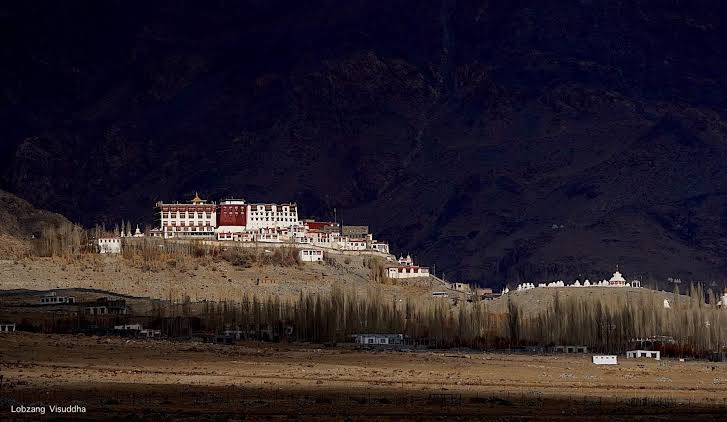
Twenty kilometres west of Leh, on the road that eventually becomes the highway to Kargil and Srinagar, a white and ochre complex sits on a hill above the village of Phyang. Its proper name is Gangon Tashi Chodzong, and the first half of that comes from the hill itself — Gang Ngonpo, the blue mountain standing behind it.
It is close enough to Leh to be a half-day. It is also the principal seat of the Drikung Kagyu order in Ladakh, and the site of one of the more remarkable things to happen in this valley in the last decade.
The founding story is worth telling properly, because the short version on most travel pages loses everything interesting about it.
Choje Denma Kunga Drakpa came to Ladakh from Mount Kailash, where he had been the meditation master at Gyangdrag Monastery. Looking for a site, he pitched his tent in a field at Phyang and was struck by a nearby hill in which he could make out three animal shapes. While meditating there he had a vision of Achi Chökyi Drölma — the protectress of the Drikung lineage — mounted on her blue horse. He read it as the sign he had been waiting for and built on the hilltop.
A rosebush is said to have sprouted on that hill afterwards, and to be still visible inside the monastery today. It is the kind of small, checkable, unspectacular detail that gets left out of guidebooks and is usually the thing visitors remember.
Achi remains the monastery's special protector. Phyang was the first place Jigten Sumgön's teachings took root in Ladakh, and it went on to become the primary centre of the Drikung mission in the region, served by a line of Chojes appointed directly by the Drikung Kyabgons.
Almost every page you will read gives 1515 as the founding year. It appears on Wikipedia, on tour operator sites, and in most of the travel writing about Phyang.
The difficulty is that the king credited with sponsoring the monastery, Chogyal Tashi Namgyal, reigned in the third quarter of the sixteenth century — roughly 1555 to 1575. Both things cannot be true. The Drikung order's own history of its Ladakh mission places Denma Kunga Drakpa's arrival under Tashi Namgyal's invitation, which puts the founding a good forty years later than the traditional date.
There is a second, more colourful version still in circulation: that Kunga Drakpa was summoned because no physician could cure King Jamyang Namgyal of leprosy, and an oracle declared that only the master at Mount Kailash could heal him. It is a good story — it involves two stones lifted from Lake Manasarovar, one inscribed with the mani mantra. But Jamyang Namgyal reigned around 1590 to 1616, decades after Kunga Drakpa had already come to Ladakh, and the Drikung order itself states plainly that the chronology does not support it.
Ladakhi records for this period are known to have gaps. The honest answer is the sixteenth century.
On the founding of PhyangLadakhi chronicles from this era have acknowledged gaps, with names likely lost through copying error or deliberate removal. So the accurate thing to say is that Phyang was founded in the sixteenth century, traditionally dated to 1515, with good reason to think it was somewhat later. Anyone who gives you a confident single year is repeating rather than checking.
You will see Phyang described as one of only two Drikung monasteries in Ladakh. The order's own account names three — Phyang, Lamayuru and Sharchukhul. You will also see references to a "900-year-old museum", which is garbled: a monastery founded in the sixteenth century cannot have a museum older than itself. What is meant is that the collection holds objects of considerable age.
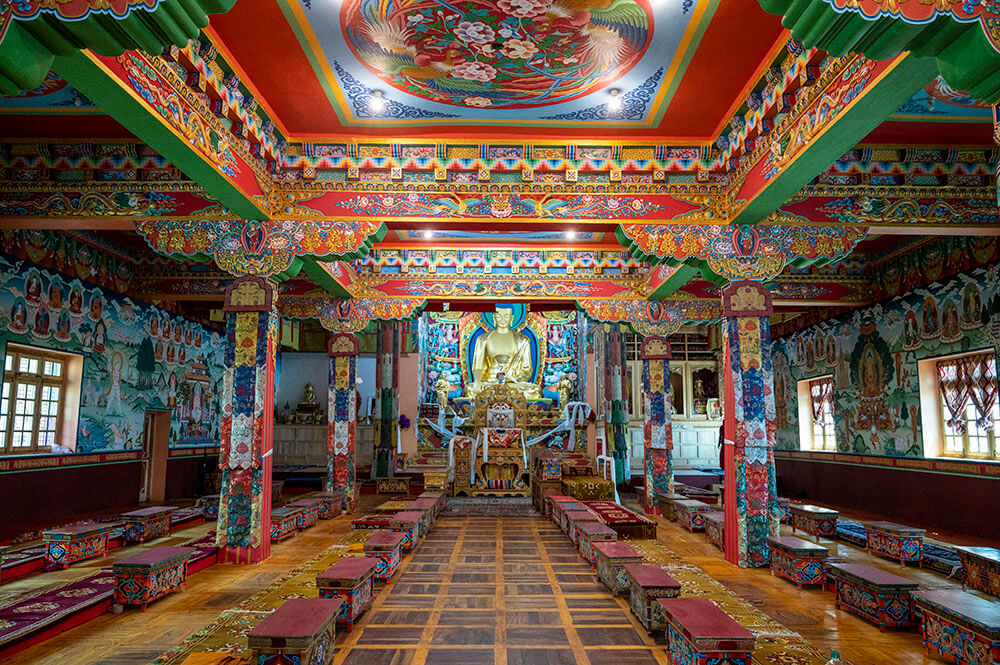
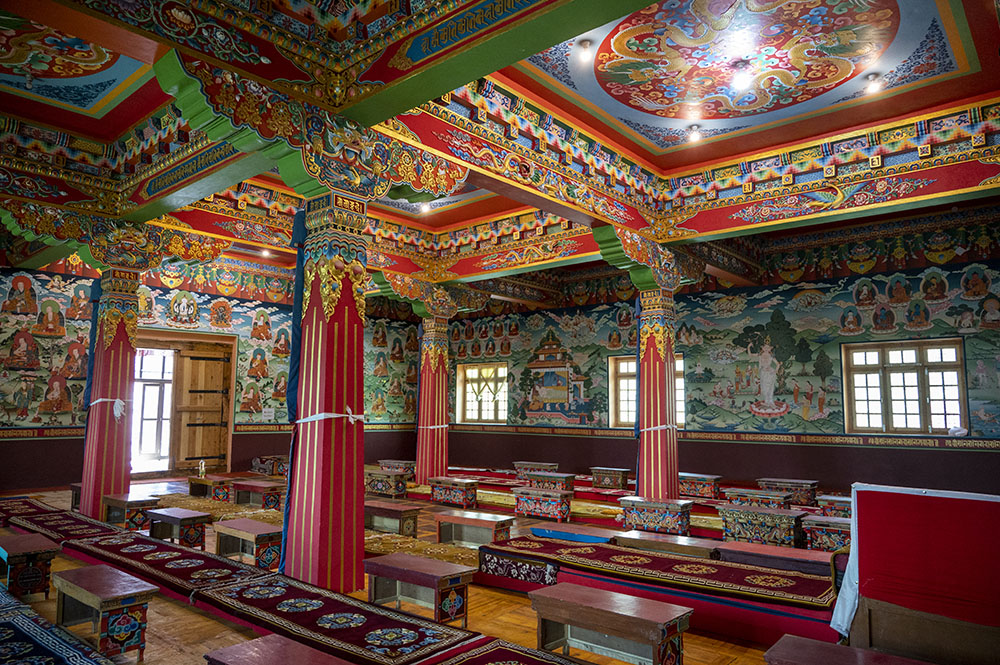
The oldest structure is the Gomkhang, the Mahakala temple, built and painted at the monastery's founding and still carrying its original murals of Mahakala and the other protector deities. For anyone with an interest in Ladakhi wall painting, this is the room that matters.
Beyond it, Phyang holds a body of old painted thangkas and statues that are significant for Drikung iconography specifically, documented in the volume Hidden Treasures from Ladakh. The monastery's collection also includes Kashmiri bronzes — some attributed to as early as the fourteenth century — alongside thangkas and an unexpected holding of Chinese, Tibetan and Mongolian firearms and weapons.
This is a working institution rather than a museum piece. More than a hundred monks are in residence. Ratnashri School was established here to give the younger ones both monastic and modern education — Tibetan, English, Hindi and mathematics alongside the ritual training. His Holiness the Drikung Kyabgon Chetsang made his residence at Phyang after escaping Tibet, before the Drikung Kagyu Institute was founded at Dehradun.
FIRST-HAND SECTION — your own material goes here. Whether the Gomkhang was open when you visited, what the climb up feels like, whether anyone showed you the rosebush, what the view back down the valley is like. Three or four honest sentences outrank everything above.
A kilometre or so downhill from the monastery, in winter, something appears that has no precedent in five hundred years of this valley's history and yet fits it exactly.
When Sonam Wangchuk's first experimental ice stupa survived into the summer heat, it was blessed by the Drikung Kyabgon Chetsang Rinpoche, who then asked the team to build a full-scale version at Phyang. SECMOL worked with the monastery through the winter of 2014 and 2015 to do it. The funding came from crowdfunding; the labour came from the villagers.
The method is almost stubbornly simple. Water is piped down from higher in the valley — a drop of around sixty-five metres — and sprayed vertically into the winter air, where it freezes on contact and accumulates into a cone. The shape is the point: a cone presents the least surface area to the sun, so it melts slowly, releasing water in spring exactly when the fields need it and the natural glaciers have not yet begun to run. Thousands of willow and poplar saplings were planted in the desert below and irrigated off the meltwater, which held into the middle of May.
The project took a Rolex Award for Enterprise in 2016.
What makes this a monastery story rather than an engineering one is how SECMOL themselves framed it. Ladakhis have long built stupas near monasteries through hala — a system of contributed communal labour, work given rather than bought. The crowdfunded version, they said, was a digital hala. Same institution, same community obligation, different century.
The ice stupas are a winter sight. Between roughly January and April there is something to see; by June there is not.
Timings and festival dates shift. Confirm before you set out — our front desk checks these regularly.
It is a sixteenth-century foundation. The traditional date given is 1515, but the king credited with sponsoring it reigned between roughly 1555 and 1575, and the Drikung order's own history places the founding under his patronage. So a mid-sixteenth-century date is the more defensible answer, and any source giving a single confident year is repeating rather than verifying.
Yes, and it is one of the easiest additions to make. It is around twenty kilometres from town on a good road, so it fits into a half-day alongside Magnetic Hill and the Indus–Zanskar confluence without any permit or high-pass driving.
Only in winter. They are built through the coldest months and melt away through spring, so the window runs roughly from January to April. By early summer there is nothing left to see.
The Drikung Kagyu order. Phyang was where the Drikung teachings first took root in Ladakh and remains the order's principal centre in the region. The order counts three monasteries in Ladakh — Phyang, Lamayuru and Sharchukhul — despite a widely repeated claim that there are only two.
No. Unlike Nubra or Pangong, Phyang lies within the freely accessible area around Leh and requires no Inner Line Permit.
Phyang sits on the western road out of Leh, which makes it one of the simplest half-days to arrange from town. Our front desk can put it together with the other stops on that stretch and tell you whether the ice stupas are standing. Hotel Kesaar Palace is on Fort Road in Leh.
