Himalayan Basecamp · From 4 September
Royal Enfield is bringing its first Himalayan Basecamp to Leh in September. Read the programme and the striking thing is how much of it has nothing to do with bikes at all — kayaks, boulders, rafts, and a recovery tent running Ladakhi medicine.
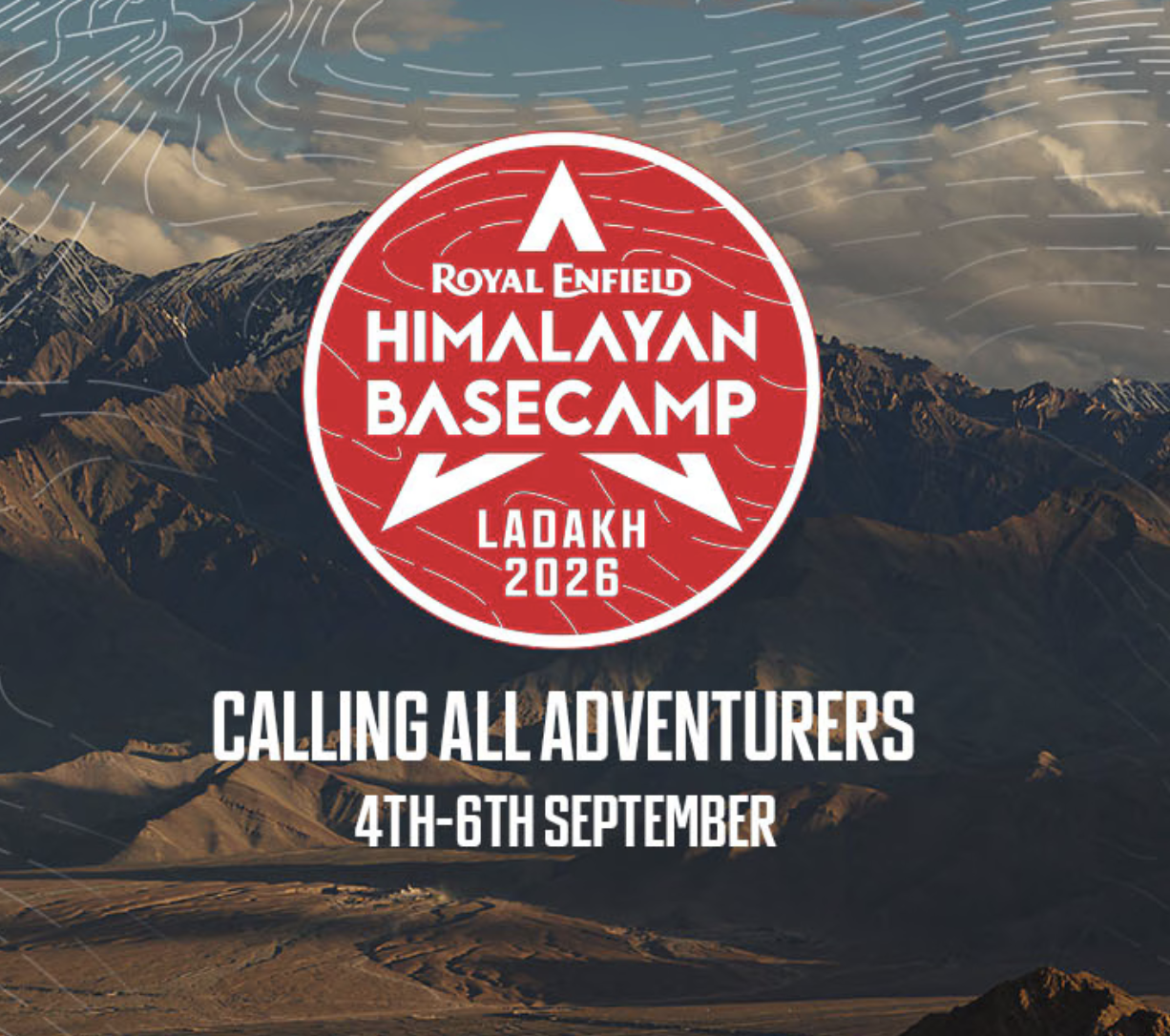
The name on it is a motorcycle company, so most people will read Himalayan Basecamp as a bike rally and stop there. That is a reasonable assumption and it is wrong, which is the interesting part.
The first edition lands in Leh from 4 September. What Royal Enfield has actually put together is a multi-discipline gathering — riders, yes, but also climbers, kayakers, rafters, mountain bikers, overlanders and hikers, with everyone expected to take part rather than stand and watch. Somewhere between half and most of the programme involves no motorcycle whatsoever.
For anyone already planning to be in Ladakh in early September, that changes what this is worth knowing about.
The Indus and the Zanskar, with rapids described as running from Grade II up to Grade V.
Billed as some of the highest rapids anywhere, run as a team discipline rather than a thrill ride.
Ladakh has more than 500 documented problems on green schist and granite. Altitude makes acclimatisation and sun protection part of the technique.
High-altitude climbs and long descents through the valleys and hamlets around Leh.
Cold-desert trekking through Trans-Himalayan terrain — an endurance test in thin air rather than a walk.
High-altitude camps between activities, which is where most of the actual talking happens at events like this.
The skills sessions are the strongest argument that this is not a branding exercise.
Bush mechanics covers punctures and flooded air filters — the specific failures that strand people when the nearest help is hundreds of kilometres away, which in Ladakh is a routine condition rather than a worst case. ADV rider training works on water crossings and deep ruts, and is framed around control rather than speed. There is 4WD and overlanding instruction covering recovery and living off-grid.
The Navigation Challenge sends participants out to find hidden GPS coordinates, working from waypoints and the night sky. Himalayan Spirit runs as a set of staged tests across the event.
These are transferable skills. Someone who learns to clear a flooded air filter at Basecamp is better equipped every subsequent time they ride here, which is more than most manufacturer events can claim.
The detail worth pausing on is in the recovery programming, which folds in Amchi practice — Sowa Rigpa, the Tibetan and Ladakhi system of medicine — alongside restorative yoga for bodies that have been working at altitude.
Amchi is not a spa treatment. It is a living medical tradition in Ladakh with its own practitioners, its own pharmacopoeia drawn largely from high-altitude plants, and a continuous history in these valleys. Seeing it placed in the recovery tent of an adventure sports event is either a genuine nod to where the event is being held, or the beginning of its commodification, and which of those it turns out to be will depend entirely on how it is run.
Either way, it is the most Ladakhi thing on the programme, and it is in the section about lying down.
Recovery sessions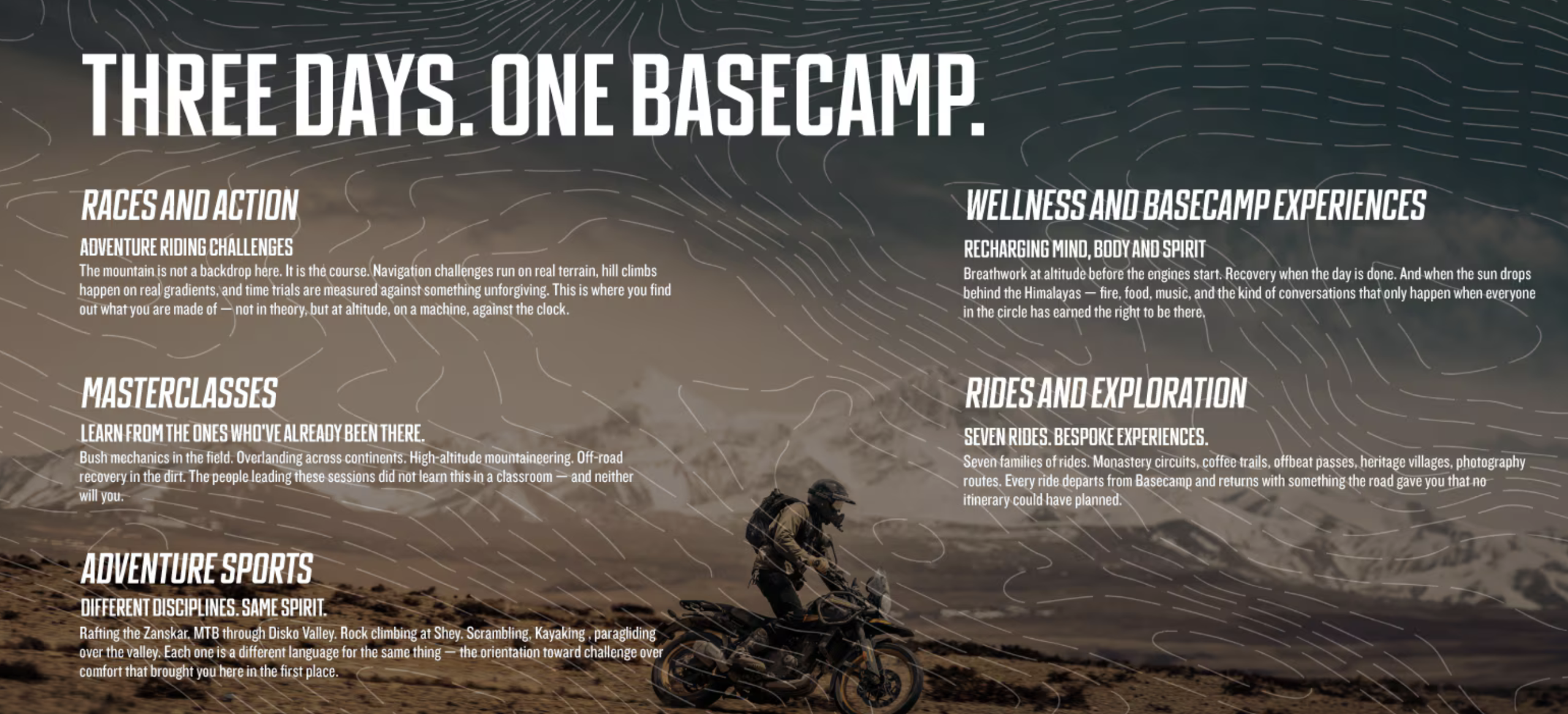
Buried at the bottom of the programme is the option that will change more trips than any of the competitions.
Ride In / Fly Out lets a rider come to Leh on their own motorcycle and then fly home, with Royal Enfield arranging for the bike to be sent back. It sounds like a convenience. It is actually a structural change to what a Ladakh motorcycle trip is.
The return leg is what makes riding here expensive in the one currency most people are short of. Delhi to Leh and back is a fortnight for most riders, and roughly half of that is spent covering ground already covered, in reverse, usually while tired. Remove it and the same leave allowance buys either a much shorter trip or — far more likely — the same total time with an extra five or six days actually in Ladakh.
Those days get spent based somewhere in Leh, going out to Nubra, Pangong, Tso Moriri, the monasteries along the Indus. Which is a better trip than the one where you turn around at the top of the pass because the drive home starts tomorrow.
The arithmetic is worth doing against your own numbers rather than anyone else's.
Here is the practical thing nobody else will tell you, and it has nothing to do with Royal Enfield.
Basecamp opens on 4 September. Bib collection for the Ladakh Marathon — the 42 km, the half, the 11.2 km and the 5 km — falls on Saturday 5 and Sunday 6 September, and every one of those runners has to be in Leh in person to collect. The ultra field has been in town since 29 August. The marathon itself runs on 13 September.
So for roughly two weeks, Leh is hosting an adventure sports festival and a marathon with a mandatory in-person check-in, back to back, with both groups staying ten days or more rather than the usual three or four.
If you are coming for either, book accommodation now rather than in a fortnight. If you are coming for neither and simply want to be in Ladakh in early September, it is worth knowing the town will be full, and that the roads close on the Sunday morning of the 13th until quarter past one.
Checked against Royal Enfield's own page on 11 August 2026. Details on that page are moving — confirm before acting.
No. The programme is explicitly multi-discipline and includes kayaking, rafting, rock climbing, mountain biking, hiking, 4WD overlanding and camping. Riders are one group among several, and a significant share of the activities involve no motorcycle at all.
In Leh, from 4 September 2026. The venue is not named on Royal Enfield's own event page as things stand, so confirm the location through your booking rather than relying on third-party reports.
An option to ride your own motorcycle to Leh and then fly home, with the bike transported back for you. It removes the return leg, which for most riders is close to half the total trip time.
Passes are sold through District. Royal Enfield's event page was still displaying an expired early-bird notice when we last checked, so it is not a reliable guide to current availability — go directly to the booking page.
Yes, and now rather than later. Basecamp sits days before Ladakh Marathon bib collection, and both events bring people who stay well over a week. The first half of September is the tightest fortnight of the year in Leh.
If you are riding in for Basecamp, flying out afterwards and wondering what to do with the days the return leg would have eaten, that is a conversation worth having with someone who lives here. Ask at the front desk. Hotel Kesaar Palace is on Fort Road in Leh.
