A Cinema From Nothing
The leading man sold jackets from a roadside stall. The item girl was a serving police constable. Monks wrote screenplays. Twenty-three years later a Ladakhi film is in French co-production. This is where that line begins.
Ladakh has been filmed by outsiders for decades. Camera crews arrive for the passes, the monasteries and the light, shoot what they came for, and leave. What is less well known is that in 2002 Ladakhis started making films of their own, in Ladakhi, for Ladakhi audiences, and built something like an industry out of almost nothing.
The film generally credited as the first is Tsesems, made in 2002, with Rinchen Norbu in the lead and Zulfiquar Ali Shah as the villain. By 2009 that industry was seven years old and had produced around twenty-six films. Ladakh Vision Group was the most established production house. Budgets ran somewhere between one and five lakh rupees. Leh had a single cinema hall.
The casting is the part that makes the whole thing legible. Rinchen Norbu, the leading man of the first Ladakhi film, sold Chinese jackets from a roadside stall for a living. Tsering Norzum, the industry's item girl, was a serving police constable. Screenplays were written by bureaucrats and by Buddhist monks. Taxi drivers played villains.
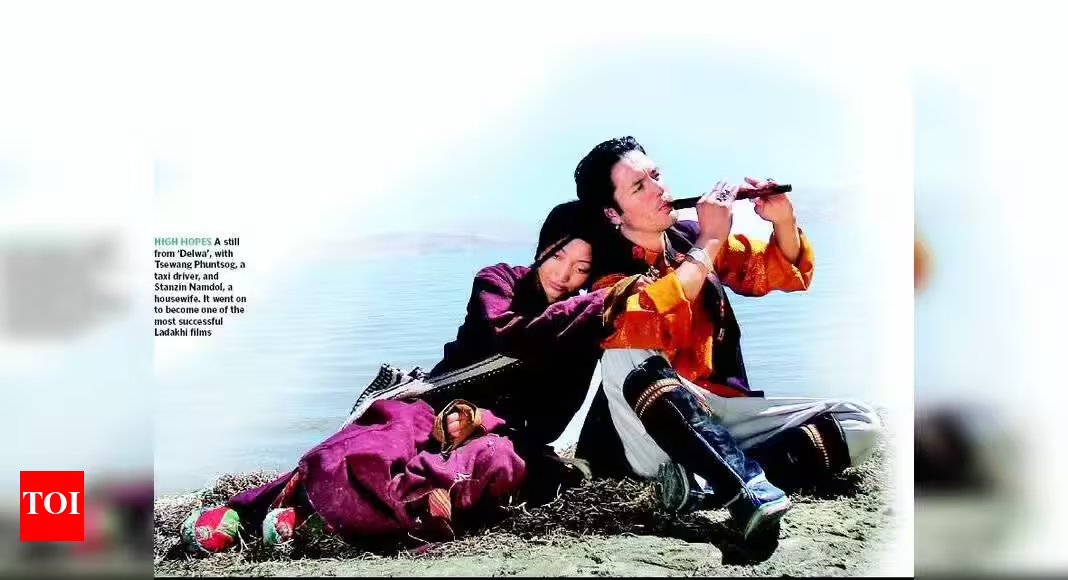
Stanzin Namdol was the region's leading actress, and around 2009 was reported to be commanding roughly a thousand dollars a film — a figure worth reading as a snapshot of that moment rather than as any kind of current rate.
Films premiered to full houses in an auditorium just off the Leh polo field. Then they went out to the villages, screened off LCD projectors with portable speakers, in places that had no cinema and never would.
They congratulated the director on climbing the trees. He told them they had used a crane. They asked what a crane was.
Ladakh Vision Group, c. 2008That exchange is the best single description of the period. Ladakh Vision Group had bought a thirty-foot crane, which allowed them to stage a sequence in Las-Del where a boy, a girl and a horse go over a cliff. The audience stood up and shouted. Some of them could not watch. Afterwards they came to congratulate the director on the dangerous business of climbing trees to get the shot.
Delwa comes from 2005, with Stanzin Namdol in the lead. Almost nothing is formally documented about it — no confirmed director credit, no published cast list, no runtime. What survives is the film itself, uploaded to YouTube, along with its songs posted separately over the years: Zesgyan Mentok, Yar-no Choney Zawa, Cham Cham Rollmey, Ldem Ldem Spang Tang.
That absence of record is itself the point. These films were not made for archives or festivals or the press. They were made for a specific audience in a specific place, played to that audience, and then persisted mostly because somebody thought to put them online. The songs have outlived the paperwork.
Foreign viewers who stumbled across this material at the time tended to describe it in the same way — striking locations, an almost western feel, held back by budget. That is a fair description from outside and a fairly useless one from inside. Watched as what it is, rather than as a low-budget version of something else, early Ladakhi cinema is a record of a place describing itself for the first time.
The timing was not accidental. The industry appeared in the same window that mobile towers went up and tourist numbers climbed, in a community that had been comparatively isolated until very recently and could feel that changing.
The response was not to reject the new technology but to point it at the problem. Ladakhis picked up twenty-first-century equipment and used it to hold on to a culture they felt was under pressure, in their own language, at a scale nobody outside the region was ever going to fund. Bollywood, which had dominated what people watched, stopped being the only option.
Two decades on, the trajectory would have been hard to predict from a thirty-foot crane in Leh.
Stanzin Dorjai, from Gya village, founded Himalayan Film House in Leh in 2006 and went on to make The Shepherdess of the Glaciers, a portrait of his own sister tending goats at altitude, which travelled the international festival circuit and collected a long list of awards. Praveen Morchhale's Walking with the Wind, shot in Ladakhi in 2017, was recognised at the National Film Awards. The Himalayan Film Festival held its first edition in Leh in 2021 and a second in 2023, organised by the UT administration and LAHDC Leh with the stated aim of connecting the region's scattered film community and turning filmmakers into working professionals.
And in November 2025, at the NFDC Waves Film Bazaar in Goa, a Ladakhi project took the top prize in the co-production features category. Kakthet — Idiot in English — is the debut feature of Stenzin Tankyong, whose shorts Sekool and Last Days of Summer played Clermont-Ferrand and Rotterdam. It is set in the nomadic grasslands of Changthang and follows Singay, an eighteen-year-old who cannot get past class 10, whose failures put his village school at risk of closing. It is produced by Ritu Sarin and Tenzing Sonam of White Crane Films with French co-producers La Belle Affaire.
Ritu Sarin called it a landmark for Ladakhi cinema — a film set in Changthang that could only have been made by a Ladakhi filmmaker.
From a jacket seller as leading man to a Rotterdam alumnus in French co-production, in twenty-three years. Delwa and the films around it sit at the beginning of that line, and they are worth watching for that reason alone.
Four ways into Ladakh that were made by Ladakhis, or close to it.
Tsesems, made in 2002, is generally credited as the first, starring Rinchen Norbu with Zulfiquar Ali Shah as the villain. The claim rests on a thin published record rather than a formal archive, which is true of most of the early industry.
Most of the early material lives on YouTube, uploaded piecemeal between 2009 and 2021 — full films in some cases, individual songs in others. Later work such as The Shepherdess of the Glaciers and Walking with the Wind has had proper festival and streaming distribution.
For most of this period Leh had a single hall, and premieres were held in an auditorium near the polo ground. Films then toured the villages on LCD projectors with portable speakers, which is how most Ladakhis actually saw them.
Yes, and at a different level. Ladakhi-language features have been recognised at the National Film Awards, shorts by Ladakhi directors have played Rotterdam and Clermont-Ferrand, and a Ladakhi feature set in Changthang won the top co-production prize at the NFDC Waves Film Bazaar in November 2025.
Ladakh is one of the most photographed places in India and one of the least often heard from. Watching something made here, in Ladakhi, before you arrive changes what you notice when you do. Hotel Kesaar Palace is on Fort Road in Leh.
