Twenty Kilometres South
A set of works was announced for Stok on 7 August. The largest single line after the village roads is for tiling a path named after the two men who go into trance there once a year — which is as good a summary of the whole approach as you will find.
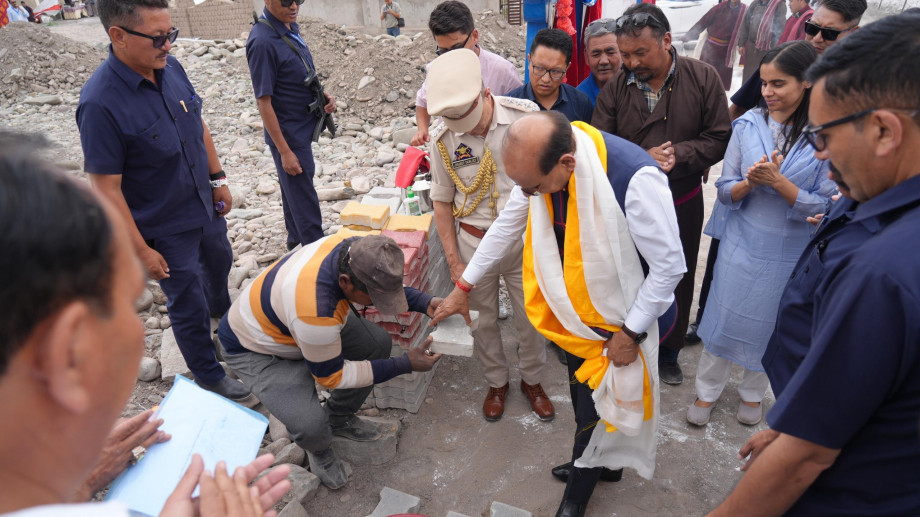
On 7 August the foundation stone was laid at Stok for a group of infrastructure and water-conservation works, covering village roads, a signage system, a footpath and the remodelling of a pond. Stok had been designated a model village during a visit on 26 March, and this is the first phase of what follows from that.
The figures are the useful part, so here they are without commentary.
The announcement does not explain the name. It says only that the path is historic and that tiling it will make access to historical and religious sites safer.
What is not in question is that Stok has oracles, and that they are the reason anyone outside Ladakh has heard of the village in winter.
On the ninth and tenth days of the first month of the Tibetan calendar — usually falling in February — Stok Guru Tsechu is held at Gurphug Gonpa, a small monastery in the village that is a subsidiary of Spituk. Monks from Spituk perform the masked dances. But the part that makes this festival different from every other one in Ladakh is that the two oracles are not monks at all. They are laymen from the village, chosen and prepared by the Spituk monks to receive the spirit of the deities.
This is worth being precise about, because a number of guides get it wrong. At Matho, a week later, the oracles genuinely are monks — the Rongtsan. At Stok they are villagers. Ordinary men who spend a month in retreat beforehand, during which they may not eat meat, and who on the day enter trance and dance along the monastery rooftops in flowing white while the village waits below with chang and tsampa for the predictions for the coming year.
Seven oracles are held to inhabit Ladakh. Two of them come through at Stok, every year.
Stok Guru TsechuThose predictions are not treated as theatre. They are taken seriously across the region, and people bring real questions to them.
So whatever the Oracle Path turns out to be on the ground, it sits in a village where a living oracular tradition is still the main event of the year — and a one-and-a-half-crore line for tiling it is the clearest signal in the announcement of what "heritage-led development" is meant to mean here.
The larger and less visible half of this is about water.
Phikar Pond, made operational on 17 April, was the first water body completed under Project Him Sarovar, a scheme launched a week earlier to capture and store snowmelt across Ladakh. It was built by clearing and stone-pitching a silted depression in the village. Reporting on the August announcement puts it as irrigating around 300 kanals and reaching close to half of Stok's households.
Zingok Pond is next. It currently leaks and holds too little to be much use. The remodelling is intended to take it from 3.4 to 6.4 million litres, which would cover almost all of Stok's agricultural land.
The wider scheme proposes 50 water bodies in its first phase — thirty in Leh district and twenty in Kargil. Stok, along with Likir, was named early as a model for it.
For anyone who has read about Ladakh's water problem, the logic will be familiar: this region does not lack water so much as receive it at the wrong time of year. Storing snowmelt so it is available when fields need it is the same problem the artificial glaciers were built to solve, approached from a different angle.
Around 20 km south of Leh, across the Indus. A comfortable half-day.
Foundation stones were laid for the first phase of works in the village: road shoulder paving in interlocking tiles at ₹1.70 crore, tiling of the Oracle Path at ₹1.50 crore, a signage system at ₹7 lakh, and the remodelling of Zingok Pond to raise its storage from 3.4 to 6.4 million litres.
Two laymen from the village, chosen and prepared by monks of Spituk monastery to receive the spirit of the deities during Stok Guru Tsechu. They undergo a month-long retreat beforehand in which they may not eat meat. This is what distinguishes Stok from Matho, where the oracles are monks.
On the 9th and 10th days of the first month of the Tibetan lunar calendar, which usually falls in February. In 2026 it was held on 25 and 26 February. Because the calendar is lunisolar the Gregorian dates shift every year, so confirm before booking a winter trip around it.
Photography is restricted during the oracle ceremonies. Follow whatever guidance is given on the day, avoid flash, and treat it as a religious occasion rather than a performance — which is what it is.
About 20 km south, across the Indus, with sources giving figures between 16 and 20 km depending on the route measured. It is a straightforward half-day from Leh with no permit required.
Stok is one of the easier half-days from Leh and one of the more rewarding, particularly if you can time it for the festival rather than the summer. If you are here in February and want to know what is on and how the roads are, ask at the front desk. Hotel Kesaar Palace is on Fort Road in Leh.
